Penguin Classics PenguinClassics RSS

Readers' Guides

Wuthering Heights: Emily Brontë


A Misunderstood Masterpiece
An Introduction to Wuthering Heights

Wuthering Heights is Emily Brontë's only novel, an impassioned, spellbinding tale considered to be one of the greatest literary works of all time. The story—as turbulent as its title suggests—transports the reader to the North Yorkshire moors to witness the drama of the Earnshaws and the Lintons, and the volatile, yet spiritual, relationship of Catherine and Heathcliff.

Wuthering Heights was first published in December 1847 under the pseudonym Ellis Bell with 250 copies printed. The novel met with harsh reactions from readers and critics who saw it as depressing and morose, and even immoral. The Examiner called it "a strange book...wild, confused, disjointed and improbable; and the people who make up the drama...are savages ruder than those who lived before Homer." Paterson’s magazine (U.S.) advised, "Read Jane Eyre… but burn Wuthering Heights."

This strong reaction was due in part to the book's intense examination of the human spirit. Readers accustomed to novels such as those by Jane Austen, published thirty-five years before, sought a realistic portrayal of the mores and manners of the English upper classes. Wuthering Heights, in contrast, focused not on society, but on the minds, hearts, and souls of its members.

Prior to the publication of Wuthering Heights, Charlotte, Emily, and Anne Brontë had published a volume of poetry under the pseudonyms Currer, Ellis, and Acton Bell; Charlotte's Jane Eyre had also been published. Confusion arose as to the identities of the Bells, and it was even thought that they might have been one person. Wuthering Heights was believed by some to have been written by the same author who had penned Jane Eyre. As Charlotte said, "The immature but very real powers revealed in Wuthering Heights were scarcely recognized; its import and nature were misunderstood; the identity of its author was misrepresented; it was said that this was an earlier and ruder attempt of the same pen which had produced Jane Eyre. Unjust and grievous error!" (Some also believed that Wuthering Heights had been written by their brother, Branwell, because a sheltered clergyman's daughter could not have created such a passionate tale.) According to the English novelist and critic W. Somerset Maugham, this notion is "absurd. . . . Given Emily Brontë's character . . . and fierce, repressed passions, which what we know of her suggests, Wuthering Heights is just the sort of book one would have expected her to write."

Despite the reasons for which Wuthering Heights was not valued in its own time, it has since been recognized as a work of extraordinary talent, elegance, and genius. One writer, Joyce Carol Oates, best summed up its power by calling Wuthering Heights an "anomaly, a sport, a freak in its own time, it can be seen by us, in ours, as brilliantly of that time--and contemporaneous with our own."

>

About Emily Brontë

Emily Brontë lived most of her life in England on the North Yorkshire moors like those depicted in Wuthering Heights. Not many details are known about her life. As one Brontë scholar stated, "Next to her genius, the most astonishing thing about Emily Brontë is the silence which surrounds her life." Charlotte Brontë declared that Emily's "disposition was not naturally gregarious; circumstances favored and fostered her tendency to seclusion; except to go to church or take a walk on the hills, she seldom crossed the threshold of home. Though her feeling for the people [all around] was benevolent, intercourse with them was never sought; nor, with very few exceptions, ever experienced."

Emily Jane was the fifth of six children born to the Reverend Patrick and Maria Brontë on July 30, 1818, in the village of Bradford, Yorkshire. Three years after Emily was born, her mother died of cancer, the first of several tragedies that would befall the Brontë family. Just before Emily's sixth birthday, she and her older sisters--Maria, Elizabeth, and Charlotte--enrolled at the Cowan Bridge School. Maria and Elizabeth both fell ill, and on May 6, 1825, Maria succumbed to her illness. The other three girls then left for home, where Elizabeth died two weeks later.

In June 1826, Mr. Brontë returned from travelling with a set of twelve wooden soldiers for Emily's brother, Branwell. Led by Charlotte and Branwell, the Brontë children created imaginative stories, poems, plays, and games about a magical world they created for "The Twelves," as they called the soldiers. They founded a kingdom on the African coast with a city named Great Glass Town, complete with a government, newspapers, magazines, generals, poets, historians, publishers, and actors. Their adventures were recorded in tiny booklets, often less than two inches square, in minute handwriting. One hundred of the booklets--whose wordcount is equal to the total published works of the three sisters--have been preserved.

Charlotte discovered Emily's poems in October 1845 and convinced her sisters to collaborate on a volume of poetry. They chose to use pseudonyms to avoid the criticism and prejudice often directed towards women writers. In May 1846, Poems (by Currer, Ellis, and Acton Bell) was published, with the Brontës paying for the costs; only two copies were sold.

Emily began working on Wuthering Heights in December 1845. She completed it in July 1846 and began submitting it for publication (along with Anne's Agnes Grey and Charlotte's The Professor). In December 1847, the publisher T. C. Newby published Wuthering Heights. One year later, on December 19, 1848, Emily died from the effects of a severe cold. Two years later, Wuthering Heights was reissued, along with a selection of Emily's poems and a biographical notice by Charlotte.

About Emily Brontë, Virginia Woolf wrote that she had the ability to "tear up all that we know human beings by, and fill these unrecognizable transparencies with such a gust of life that they transcend reality. . . . She could free life from its dependence on facts; with a few touches indicate the spirit of a face so that it needs no body; by speaking of the moor make the wind blow and the thunder roar."


Discussion Questions

1) Why do you think Emily Brontë chose to unfold the story through the secondary sources of Ellen's narrative, Mr. Lockwood's two visits, and Catherine's diary? How would the story have differed if it had been told chronologically? Do you trust the narrators' versions of the events that took place? Or are they, from time to time, a bit unreliable?

2) Compare Catherine's love for Heathcliff with her love for Edgar: What are the defining characteristics of each relationship? Do you think Catherine regrets her choice of husband?

3) When Heathcliff visits Catherine for the last time before she dies, she says to him, "You have killed me--and thriven on it, I think." Nearly twenty years later, when Heathcliff is approaching death, he says, "I have to remind myself to breathe--almost to remind my heart to beat!" Did Heathcliff and Catherine believe the only way they could be together was in death? Did they, somehow, will themselves to die?

4) The characters in the novel have a great capacity for violence and hatred, and revenge is one of Heathcliff's greatest motivations. Is Heathcliff justified in the revenge he takes on Hindley? Do you think Heathcliff's childhood experiences at Wuthering Heights contributed to his monstrous behavior as an adult?

5) One critic stated that Wuthering Heights is "truly a novel without a hero or heroine." What do you think of this statement? Is Heathcliff a hero or a villain?

6) Wuthering Heights is considered by many to be one of the greatest romances in literature. Do you agree with this? What is your definition of a romantic novel? Must a great romance have a happy ending?


Related Titles

By Emily Brontë:
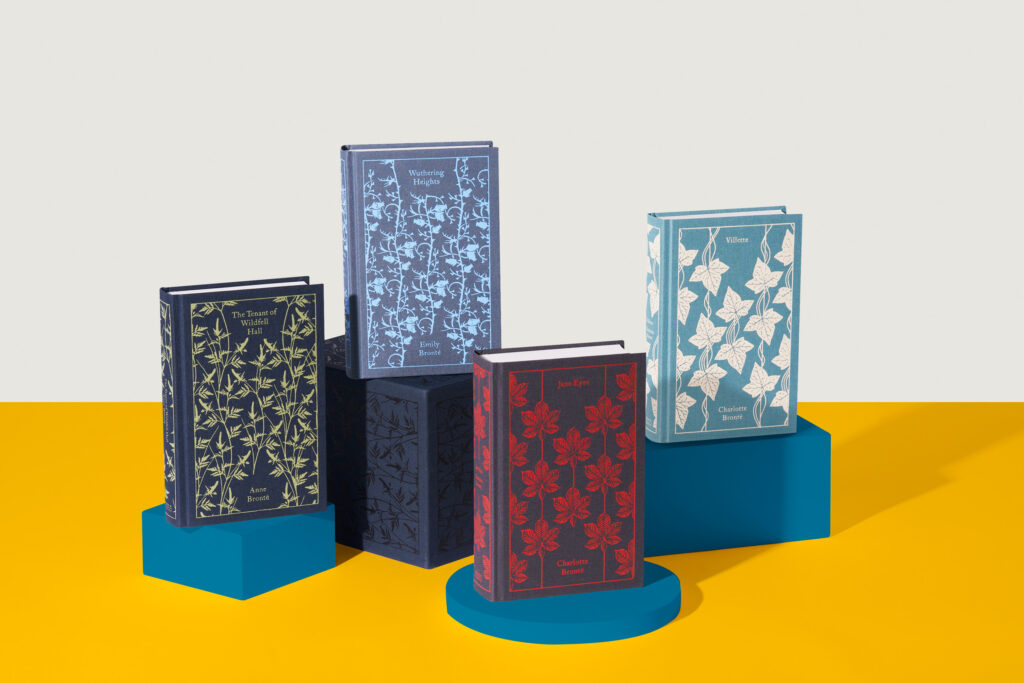
The Complete Poems
Edited and Introduced by Janet Gezaii
0-14-042352-4

By Anne Brontë:
Agnes Grey
Edited and Introduced by Angeline Goreau
0-14-043210-8

The Tenant of Wildfell Hall

Edited by G. D. Hargreaves
0-14-043137-3

By Charlotte Brontë:
Jane Eyre
Edited by Q. D. Leavis
0-14-043011-3

The Professor
Edited and Introduced by Heather Glen
0-14-043311-2

Shirley
Edited by Andrew and Judith Hook
0-14-043095-4

Villette
Edited by Mark Lilly
0-14-043118-7


Penguin Classics wishes to thank and credit the following writers and books for information used in creating this Reading Group Guide:

Miriam Allott, Emily Brontë: Wuthering Heights, Revised Edition, London, Macmillan, 1992.

Phyllis Bentley, The Brontës, New York, Haskell House Publishers, 1975.

Godfrey Fox Bradby, The Brontës and Other Essays, New York, Oxford University Press, 1967.

Frederick R. Karl, An Age of Fiction: The Nineteenth-Century British Novel, New York, Farrar, Straus & Giroux, 1968.

Cherie D. Abbey and Janet Mullane, editors, Nineteenth-Century Literature Criticism, Vol. 16, Detroit, Gale Research Co., 1987.

Joann Cerritto and Paula Kepos, editors, Nineteenth-Century Literature Criticism, Vol. 35, Detroit and London, Gale Research Inc., 1992.